Tin Can Titans by John Wukovits
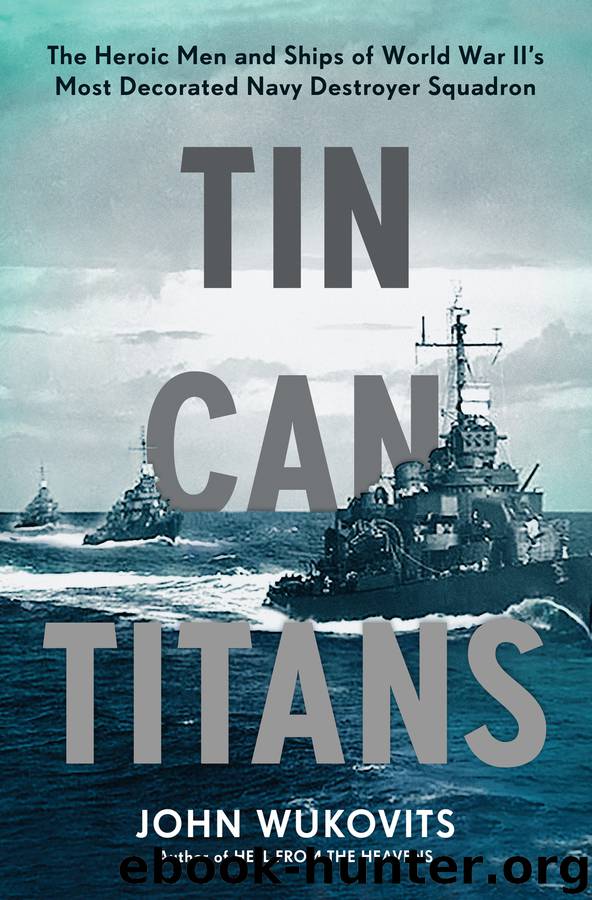
Author:John Wukovits
Language: eng
Format: epub, mobi
Publisher: Da Capo Press
Published: 2017-03-14T04:00:00+00:00
“A Great Mass of Flames and Explosions”
Over the next four months Desron 21 was involved in three other major surface engagements with the Japanese, all brought about by efforts to halt the Tokyo Express from rushing in more reinforcements. Senior commanders continued to frustrate destroyer skippers by keeping their ships tied closely to the cruisers, but some tactical alterations gave hope that one day destroyers could display the offensive wallop they packed.
On July 12, another sweltering afternoon, Nicholas, O’Bannon, Taylor, Jenkins, and Radford joined other ships to steam up the Slot and intercept the Japanese. MacDonald’s raw crew had earlier been unnerved by the ferocity of surface engagements, “but by this time my boys were getting over the great fear of the battle of Guadalcanal and as I used to tell them not all battles are as terrible as that one.”31
When the next morning reconnaissance aircraft spotted the Japanese, to MacDonald’s dismay Ainsworth formed the usual one-column battle disposition, with his cruisers nestled protectively between two groups of destroyers. Instead of immediately opening with a torpedo launch, he delayed firing until he closed the range to seven thousand yards. Rear Admiral Shunji Izaki, who had swept down from Rabaul with the light cruiser Jintsu, five destroyers, and four destroyer-transports, now carried a radar-detecting device that picked up the electric impulses from US radar. He launched his torpedoes at 1:08 a.m., one minute before Ainsworth gave his belated order to attack. Those sixty seconds made all the difference.
Japanese torpedoes hit the Australian cruiser Leander, killing twenty-eight and knocking her out of the battle, but American salvos ripped into Jintsu, disabling her steering gear, followed by two Desron 21 torpedoes smacking into Jintsu’s after engine room and Number Two stack. The cruiser split in half and sent Izaki and most of the 483 officers and men to the bottom.
At that point Ainsworth decided to pursue the fleeing enemy. When radar picked up an unidentified group of ships closing on the area, Ainsworth wasted seven minutes trying to determine whether they were Japanese or part of his destroyer screen. By the time he gave the order to fire, another wave of torpedoes had struck his two cruisers and the destroyer Gwin. The cruisers were able to steam away, but Gwin had to be scuttled.
Izaki’s Japanese destroyer-transports successfully unloaded their reinforcements. In giving his life and losing a cruiser, Izaki succeeded in his main mission and knocked three American cruisers out of the war, one permanently. Combined with Kula Gulf a week earlier, the battle again revealed shortcomings in American surface tactics. In both actions Japanese torpedoes churned toward their targets with Ainsworth’s guns still silent.
The Long Lance torpedoes continued to confound Halsey and Nimitz. Fleet intelligence examined a retrieved Long Lance in early 1943 but failed to disseminate the results to Halsey. The commander of the stricken Helena warned Ainsworth to draw no closer to his foe than ten thousand yards, a distance that would offer a better chance to evade the weapons,
Download
This site does not store any files on its server. We only index and link to content provided by other sites. Please contact the content providers to delete copyright contents if any and email us, we'll remove relevant links or contents immediately.
| Africa | Americas |
| Arctic & Antarctica | Asia |
| Australia & Oceania | Europe |
| Middle East | Russia |
| United States | World |
| Ancient Civilizations | Military |
| Historical Study & Educational Resources |
The Radium Girls by Kate Moore(12041)
100 Deadly Skills by Clint Emerson(4936)
Rise and Kill First by Ronen Bergman(4803)
The Templars by Dan Jones(4698)
The Doomsday Machine by Daniel Ellsberg(4495)
The Rape of Nanking by Iris Chang(4227)
Killing England by Bill O'Reilly(4013)
Stalin by Stephen Kotkin(3974)
Hitler in Los Angeles by Steven J. Ross(3950)
12 Strong by Doug Stanton(3559)
Hitler's Monsters by Eric Kurlander(3355)
Blood and Sand by Alex Von Tunzelmann(3209)
The Code Book by Simon Singh(3201)
Darkest Hour by Anthony McCarten(3138)
The Art of War Visualized by Jessica Hagy(3015)
Hitler's Flying Saucers: A Guide to German Flying Discs of the Second World War by Stevens Henry(2761)
Babylon's Ark by Lawrence Anthony(2687)
The Second World Wars by Victor Davis Hanson(2531)
Tobruk by Peter Fitzsimons(2524)
